
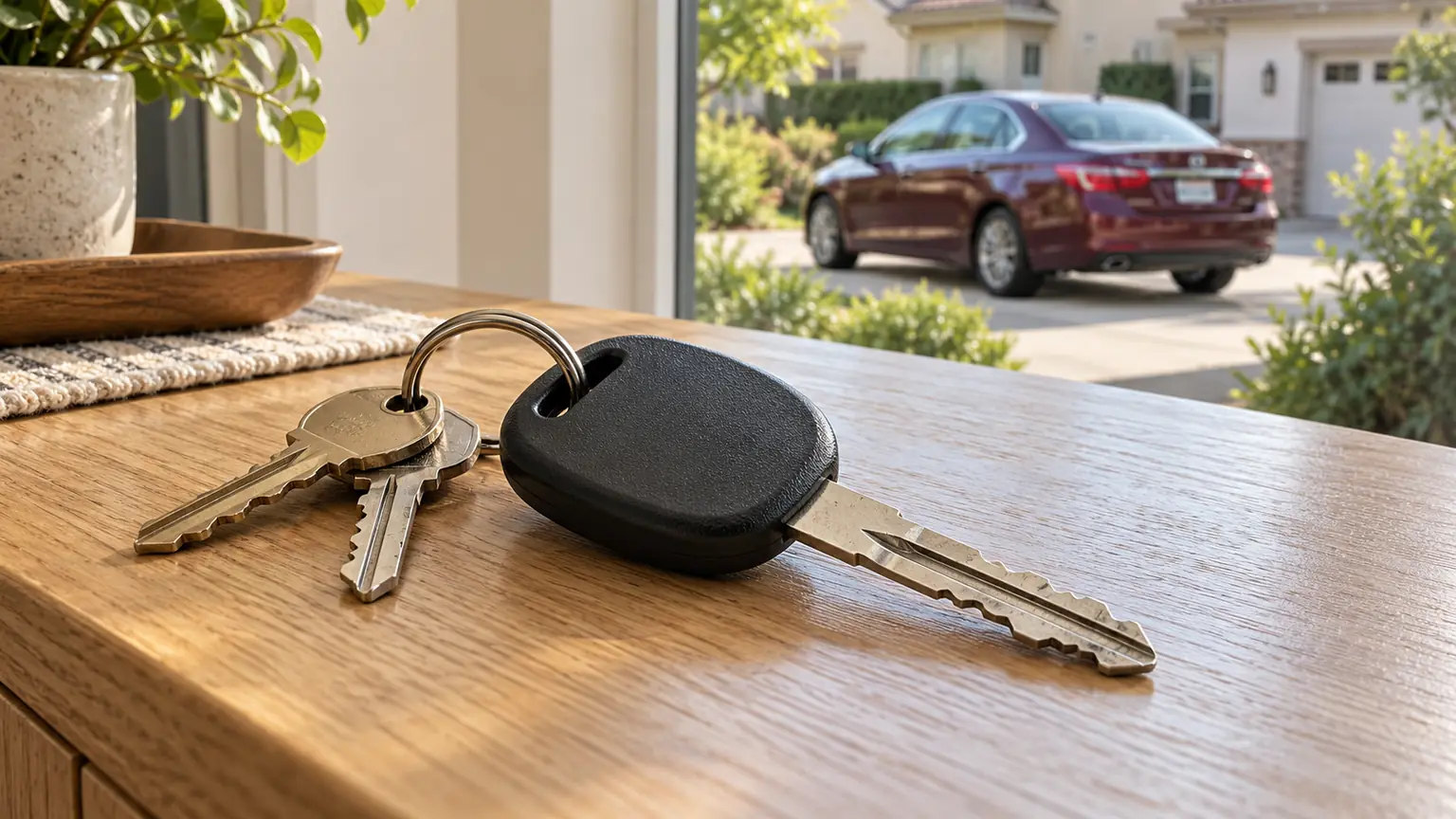
You have a spare car key cut at a hardware store. It fits the door, turns in the ignition, and looks almost identical to your original key. But when you try starting the engine, the vehicle refuses to run.
The problem may not be the metal key at all.
Many vehicles use an electronic security feature that checks whether a key is authorized before allowing the engine to start. That authorization comes from a tiny component hidden inside the key’s plastic head.
A transponder key is a car key containing an electronic chip that communicates with the vehicle’s immobilizer system. When the vehicle recognizes an authorized chip, it permits engine starting. If authentication fails, the immobilizer can prevent the engine from operating.
This technology explains why cutting a replacement key and programming it are sometimes two separate jobs.
Understanding the process can help you recognize the difference between a mechanical key problem and an electronic authorization issue.
The Small Chip That Changed Car Key Security
Traditional mechanical car keys rely on their physical cuts.
When the correct key enters a matching lock cylinder, its shape allows the mechanism to turn.
A transponder car key adds another layer.
Inside the plastic head is a chip designed to communicate with the vehicle’s electronic security system.
The metal blade still performs its mechanical function, but the chip supplies an electronic credential.
Both functions may be required to start the vehicle.
This design helps reduce unauthorized engine starting using an incorrectly coded key.
It does not make a vehicle impossible to steal, and security capabilities vary between manufacturers and model years.
The important change is that matching the lock cylinder no longer guarantees engine authorization.
What Happens When You Turn a Transponder Key?
The interaction takes place in moments, usually without the driver noticing.
Although implementations differ, a conventional transponder ignition system generally follows this sequence.
The Vehicle Detects the Key
When you insert the key and turn the ignition to the appropriate position, an antenna near the ignition cylinder communicates with the transponder.
The antenna is connected to the vehicle’s immobilizer electronics.
The Chip Responds Electronically
In many conventional systems, the vehicle generates a low-frequency electromagnetic field that powers the passive transponder.
The chip responds with information used for authentication.
The key doesn’t need to connect physically to an electrical contact inside the ignition.
The Immobilizer Checks Authorization
The vehicle evaluates the transponder response against its stored security information.
Some systems use an identification code, while others use more sophisticated cryptographic authentication.
The exact process depends on the vehicle.
The Vehicle Permits or Blocks Starting
If authentication succeeds, the immobilizer allows the relevant engine control systems to operate.
If it fails, the engine may not start or may stop shortly after starting, depending on the vehicle.
The metal key might still turn normally.
That’s why a correctly cut but unprogrammed replacement can fail to start the car.
Does a Transponder Key Have a Battery?
This is one of the most common misunderstandings.
Many conventional transponder chips are passive and do not require a replaceable battery.
They receive the energy needed for communication from the vehicle’s electromagnetic field.
That is different from the battery used to power remote locking buttons.
A key can contain both a passive immobilizer chip and a battery-powered remote transmitter.
If the remote battery dies, the vehicle may still recognize the transponder for engine starting.
However, smart key systems and vehicle-specific backup procedures work differently.
Always consult the owner’s manual before assuming a dead remote battery prevents the car from starting.
How Can You Recognize a Transponder Car Key?
You usually cannot identify the chip simply by examining the metal blade.
The electronic component is commonly embedded in the plastic head, where it isn’t visible without opening or damaging the housing.
A thick plastic key head can be a clue, but it isn’t definitive.
Some transponder keys resemble ordinary mechanical keys.
Others include integrated remote buttons.
The most reliable way to identify the system is to check the vehicle’s year, make, model, and manufacturer’s documentation.
An automotive locksmith may also use appropriate equipment to identify the key type.
Avoid breaking open a working key to search for a chip.
Damaging the housing or internal component could turn a functioning key into a replacement job.
Why a Perfectly Cut Key Might Not Start Your Car
Imagine losing your only working key.
You obtain a replacement blank, and someone cuts the blade to match your vehicle’s lock.
The new key opens the door and turns the ignition.
Yet the security indicator flashes, and the engine won’t start.
This situation illustrates the difference between two separate requirements.
Mechanical compatibility means the blade matches the lock.
Electronic authorization means the vehicle recognizes the transponder credential.
A key may satisfy the first requirement without satisfying the second.
The replacement might contain an unprogrammed chip, an incompatible transponder, or no chip at all.
An ignition or immobilizer fault could also produce a similar result.
The correct next step is identifying the actual cause, not repeatedly cutting another identical blade.
What Does Transponder Key Programming Mean?
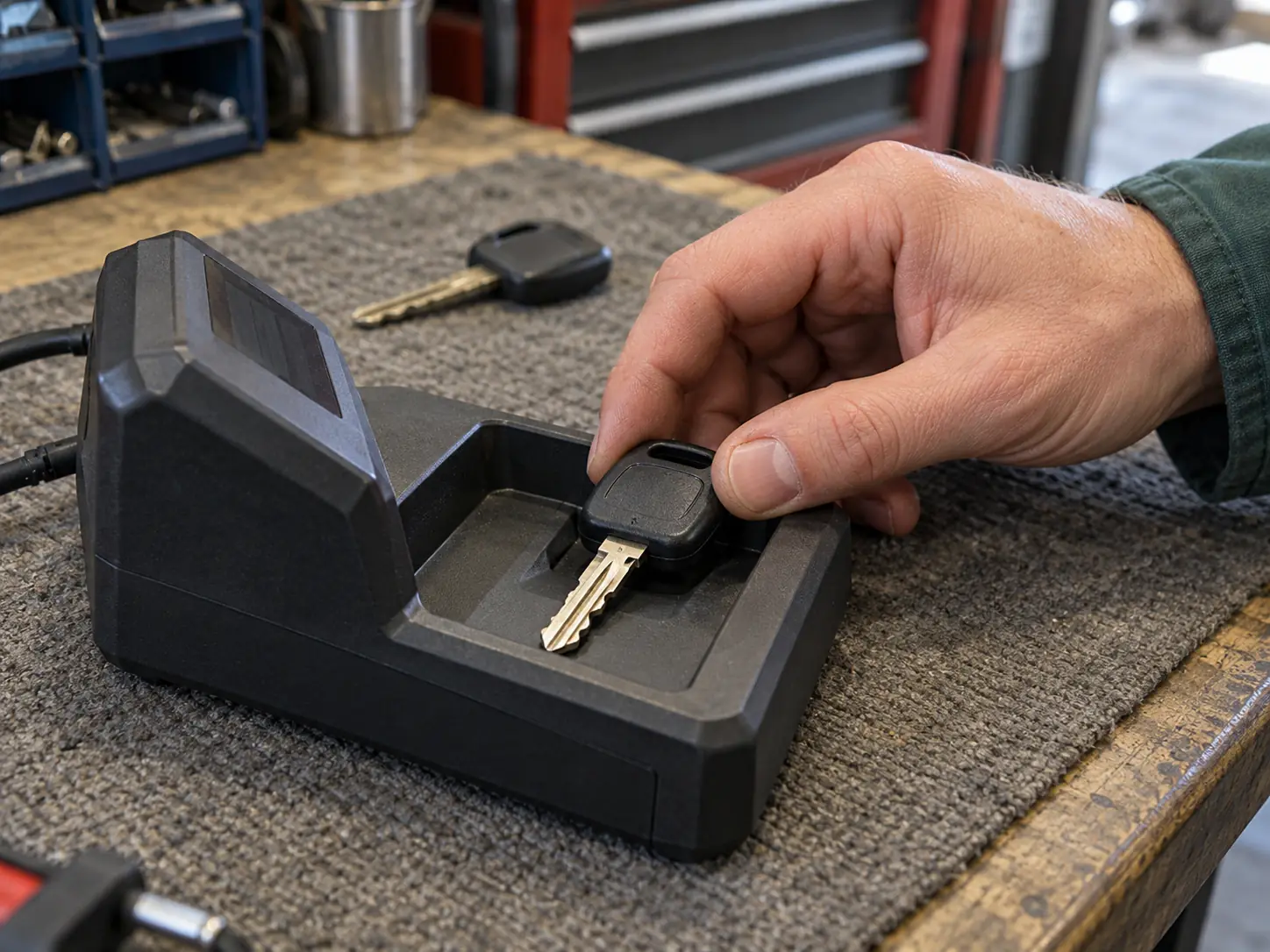
Programming establishes the electronic relationship between a compatible key and the vehicle’s security system.
Depending on the manufacturer, the process may involve registering a new credential, performing a prescribed security procedure, or using specialized automotive diagnostic equipment.
Some vehicles support limited owner programming when working keys are already available.
Others require professional equipment and authorized access procedures.
There is no universal programming sequence that works across every brand.
A technician must identify the correct transponder technology and determine whether the vehicle supports the requested service.
Lock & Key Pros offers transponder key programming through its automotive locksmith services for supported vehicles.
Service requirements depend on the vehicle and available keys.
Is Cutting a Key the Same as Programming It?
No. These are different operations.
| Key service | What it accomplishes | What it doesn’t automatically do |
|---|---|---|
| Key cutting | Creates a blade that matches the mechanical lock | Registers a transponder |
| Transponder programming | Establishes electronic authorization | Corrects an improperly cut blade |
| Key duplication | Creates another usable key when properly completed | Guarantees compatibility without verification |
| Remote programming | Configures supported remote-entry functions | Always program engine immobilizer authorization |
Some vehicles combine several functions in one key assembly.
That doesn’t mean every function uses the same procedure.
A replacement should be checked for the features your vehicle actually requires.
What Happens if a Transponder Chip Stops Working?
A failed or unrecognized transponder may prevent the vehicle from starting.
However, a no-start condition alone doesn’t prove the chip is defective.
Possible explanations include an incompatible replacement key, damaged key electronics, an immobilizer antenna issue, or a vehicle electrical fault.
A weak vehicle battery can also interfere with normal starting behavior.
The most useful clues come from observing the ignition response and security indicator.
If a second programmed key starts the vehicle normally, the original key becomes a stronger suspect.
If neither key works, further vehicle-side diagnosis may be necessary.
Avoid repeatedly attempting to start the engine when the vehicle displays an immobilizer warning.
Consult the manufacturer’s guidance and seek qualified assistance.
Can a Transponder Key Lose Its Programming?
People sometimes describe any key recognition problem as a key that has “lost programming.”
That explanation isn’t always accurate.
A transponder can remain correctly registered while the vehicle fails to recognize it because of damage, interference, or a fault elsewhere in the system.
Certain vehicle repairs or security-module replacements may require keys to be registered again.
But routine use doesn’t necessarily erase the chip’s authorization.
Before paying for reprogramming, ask the technician to determine whether the problem is actually related to key registration.
That distinction can prevent unnecessary replacement parts and repeated service attempts.
What if You Lose Your Only Transponder Key?
Losing the last working key creates a different situation from making a spare.
When you have an existing functional key, it may help with identification and certain supported programming procedures.
Without one, the locksmith may need additional vehicle-specific information and equipment.
The service can involve identifying a compatible blank, cutting the mechanical blade, and registering the electronic credential.
Availability varies considerably between vehicle models.
Some systems have restrictions that affect how replacement keys can be added.
Before requesting service, prepare the vehicle’s year, make, model, and location.
You should also expect to provide proof that you own or are authorized to use the vehicle.
Lock & Key Pros lists car key replacement among its automotive services for supported vehicles.
Can You Duplicate a Transponder Key?
Yes, many transponder keys can be duplicated, but the process depends on their electronic design.
A working key can sometimes be used to create another authorized credential through an appropriate programming procedure.
Some transponder technologies also support cloning using compatible equipment, while others require registration directly with the vehicle.
Cloning and vehicle registration are not interchangeable methods.
A professional should identify the system before deciding which approach is supported.
Importantly, duplicating the metal blade alone doesn’t necessarily create a working engine-start key.
If you want a reliable spare, have both mechanical operation and engine authorization verified.
Are Transponder Keys More Secure Than Ordinary Keys?
Transponder technology adds an electronic requirement beyond the mechanical blade.
That can make unauthorized starting more difficult than with a traditional mechanical-only ignition system.
However, the protection depends on the particular immobilizer design and its implementation.
Older and newer systems may use different authentication methods.
No vehicle security feature guarantees complete protection against theft.
A transponder key also doesn’t prevent someone from physically damaging a door lock or stealing property left inside a vehicle.
It is best understood as one component of a broader vehicle security system.
Does Every Car Use a Transponder Key?
No.
Vehicle key technology varies by manufacturer, model, year, and equipment configuration.
Some older vehicles use mechanical keys without electronic immobilizer authorization.
Many later vehicles use transponder-equipped ignition keys.
Other vehicles use proximity-based smart keys and push-button starting systems that incorporate electronic authentication in a different format.
Even within the same model family, key configurations can vary.
That’s why the vehicle’s exact details matter when ordering a replacement.
Don’t assume a key type based only on the car’s appearance or the presence of remote buttons.
Common Misunderstandings About Transponder Keys
Several assumptions can lead homeowners and drivers toward the wrong service.
My key turns, so the chip must work. Not necessarily. Mechanical operation and electronic authorization are separate.
A dead remote battery means the transponder is dead. Not necessarily. Many conventional immobilizer chips are passive.
Any key with the same shape will work. The blade may fit while the chip remains incompatible.
Every replacement key can be programmed at home. Procedures vary, and some vehicles require specialized equipment.
A flashing security light always means a broken key. The light may indicate a recognition problem, but further diagnosis is necessary.
Understanding these differences makes conversations with an automotive locksmith more productive.
What Should You Confirm Before Ordering a Replacement?
A replacement key should be selected for the exact vehicle, not merely for a similar-looking housing.
Before purchasing or approving service, confirm:
- The vehicle’s year, make, and model.
- Whether the key uses a transponder or another authentication system.
- Whether the mechanical blade requires cutting.
- Whether an existing programmed key is available.
- Whether remote-entry buttons are included.
- Whether programming is supported for that vehicle.
- Whether the quoted price includes cutting and programming.
If buying a key online, confirm compatibility before assuming a locksmith can register it.
A visually identical key may contain different electronics.
Frequently Asked Questions
What is the purpose of a transponder key?
A transponder key provides an electronic credential that the vehicle’s immobilizer checks before permitting engine starting.
Will a transponder key work without a battery?
Many conventional transponder chips work without their own battery because the vehicle powers them during authentication. Remote-entry functions may still need a battery.
Can a locksmith program a transponder car key?
Qualified automotive locksmiths can program transponder keys for supported vehicles, subject to compatibility and security-system requirements.
Why does my transponder key unlock the door but not start the engine?
The blade may match the mechanical lock while the immobilizer does not recognize the electronic credential.
Can a damaged transponder chip be repaired?
The appropriate solution depends on the damage and key design. Some housing problems are repairable, while failed electronic components may require a compatible replacement.
Know What Your Car Key Needs Before Replacing It
A transponder key is more than a piece of cut metal.
Its hidden chip works with the vehicle’s immobilizer to help determine whether engine starting is authorized.
That is why a replacement key may need both precise cutting and electronic programming.
If your key has been lost, damaged, or stopped starting the vehicle, the most useful first step is identifying the key system and confirming the cause.
Lock & Key Pros provides automotive key replacement and transponder programming for supported vehicles.
Visit the Lock & Key Pros automotive locksmith service page to discuss your vehicle, available keys, and replacement options before scheduling service.
- #transponder keys
- #car keys
- #immobilizer